


The world's first jigsaw puzzle was probably created in 1766 – at least, it is the first jigsaw puzzle we know of today. Map dealer John Spilsbury sawed up a map of Great Britain glued to a wooden board, presumably for educational purposes.
He sold it under the name:
"Teaching materials to facilitate geography lessons."
The cut surfaces were still smooth at that time. Serrations as we know them today only appeared around 1850.
So puzzles have a long history and continue to enjoy great popularity among young and old alike. No wonder: puzzles are not only fun, they also help you keep your mind agile and train your fine motor skills.
- Puzzles are still popular even after many years—find out why in this article!
- Puzzles train the brain.
- Puzzling is a wonderful indoor hobby and dispels boredom on rainy days.
- There is a wide selection of wooden and cardboard puzzles – there is something for everyone.

Where and how was jigsaw puzzle invented?
As mentioned above, John Spilsbury's puzzle from 1766 is known to be the first documented puzzle. Whether he was really the inventor cannot be said with certainty in retrospect. Around the same time, a woman named Jeanne-Marie Leprince de Beaumont used cut-up cards for educational purposes.
The fact that puzzles were invented for educational purposes already shows their value for the workings of our brain. Presumably, the idea behind puzzle cards was that learners would be able to memorize the cards better if they had put them together themselves.
Except for the interlocking system, little has changed since then. The principle has remained the same: an image is cut or sawn apart and can be reassembled afterwards.
The possibility of interlocking pieces, which emerged in the mid-19th century, added another factor to the puzzle: the pieces could be matched not only by their image but also by their shape. This made it possible to create puzzles without images, in which the pieces could be assembled solely on the basis of their unique shape.
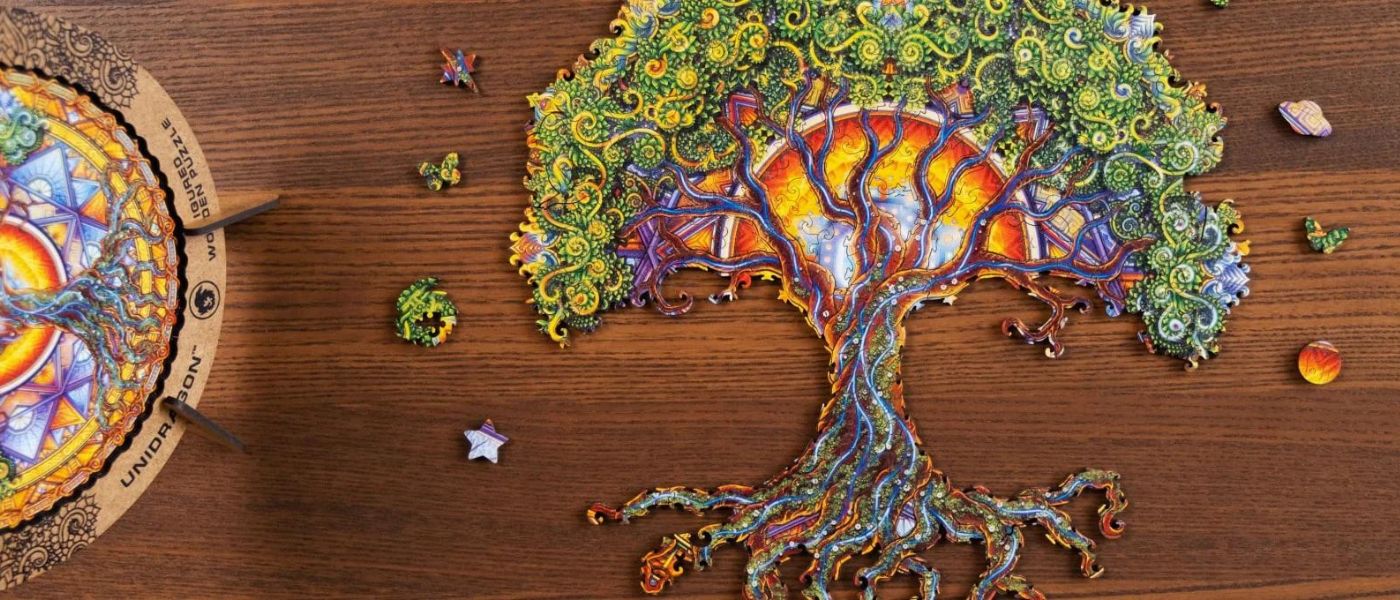
You can find many different wooden puzzles in our MagicHolz .
Why are puzzles so popular?
Puzzling is not only distracting, it also makes you happy. So it's no wonder that it's so popular. After a stressful day, concentrating on an activity helps you switch off and wind down after work. In this case, puzzling takes on a meditative role.
You may also have noticed that you feel happier after doing a puzzle than you did before—there is a scientific reason for this, which you will learn more about later in this text.
Then there is the motif of the puzzle. Most people naturally choose a picture that they enjoy looking at and that gives them a positive feeling. Intently studying a picture can also help to distract you from other stresses.

Another advantage of puzzles is that they are suitable for all age groups. They are available in a wide range of difficulty levels. From wooden puzzles with just a few pieces, ideal for toddlers who arestill developingtheir motor skills, to 1,500-piece puzzles for professionals who enjoy spending several days working on a puzzle.
Puzzling is also a wonderful hobby for at home that can be enjoyed in the comfort of your own four walls when you're wondering what to do in bad weather.
Is doing puzzles healthy?
Puzzling can have a positive effect on our thinking and our psyche. The activity of puzzling engages both sides of the brain.
- While the left brain is responsible for our logical thinking and works analytically,
- The right side of the brain is responsible for our creativity.
When Sort by pieces and figuring out which shape fits in a certain place, we use the left side of our brain. When putting the whole thing together, however, we use the right side.
This trains the interaction between both hemispheres of the brain, which we can use as "brain jogging." Studies suggest that short-term memory and concentration can be improved by doing puzzles. Some even suggest that puzzles can prevent dementia or Alzheimer's disease.

What are the benefits of doing puzzles?
As mentioned above , puzzles promote our cognitive abilities on various levels. But puzzles also simply put us in a good mood! Puzzles make us happy—and it's not just puzzle fans who are convinced of this. People like to achieve goals—achieving a goal leads to a feeling of success.
Expert tip: When doing a puzzle, you repeatedly achieve smaller goals and ultimately a larger goal. This means that you repeatedly experience a sense of achievement when doing a puzzle, which is very satisfying. Once you have completed the puzzle, you can be proud of yourself—and that feels good too!
1. Puzzling leads to the release of dopamine.
Dopamine is a happiness hormone that is released whenever we experience success. Dopamine activates the reward centerin our brain, triggering feelings of happiness and even euphoria. This form of activation of the reward center can boost our motivation.
As described above, solving puzzles repeatedly leads to partial successes, which stimulates the reward center and releases dopamine. Solving puzzles therefore makes you happy.
2. Puzzles promote patience
In addition to concentration, puzzles also train patience. They increase perseverance. The small releases of dopamine make it easier for us to "stick with it" and persevere.
The resulting increase in concentration span and stamina can lead to greater patience in the long term.

3. Puzzles are relaxing
Flashing screens, advertisements, constantly popping up messages—it's not exactly relaxing. Stress and hecticness are often the result of our constant availability and the sensory overload caused by social media.
Puzzles are an excellent way to switch off and take your mind off things. Puzzles are a calming activity that slow down everyday life. The tactile experience also helps you relax.
When everything takes place in the digital space, our sensory perceptions fall by the wayside. However, these can be important for achieving peace of mind. Puzzles are relaxing for another reason too: we humans need to accomplish achievable tasks in order to relax internally.
It is not uncommon for our workload to be simply too large to even begin to tackle. In such cases, approaching a task like a puzzle can help: the project is feasible and will eventually be completed.
4. Puzzles as brain training
Puzzling can also be used as brain training, as it engages both sides of the brain and thus promotes short-term memory and concentration. Puzzling can also train your ability to combine different elements. In this way, puzzling can train your cognitive abilities.
5. Puzzles improve the imagination
Because the pieces always have to be "scanned" and sorted by shape and color when doing a puzzle, it can increase the imagination. Children's puzzles are particularly well suited for training spatial thinking skills in children. This has a particularly positive effect on children, but adults can also benefit from it.
6. Puzzles have a positive effect on analytical skills
Puzzling requires various skills, including analyzing the image in front of us and dividing it into small sections. This helps train our analytical skills.
As described above, the left hemisphere of the brain is responsible for analytical thinking. By using it when doing puzzles, we can strengthen our analytical thinking patterns. Various puzzle tips can help us to approach a puzzle in the most analytical way possible.
7. Puzzles train fine motor skills
The feel of the particles has already been mentioned. Whenever touch and delicate shapes play a role that requires not only recognition but also delicate assembly, our fine motor skills come into play.
Like all physical skills, fine motor skills are best trained through practice. That's why puzzles are an ideal way to improve fine motor skills.

Conclusion
Puzzling has a long history and remains a popular hobby for people of all ages. It promotes cognitive skills such as thinking, concentration, imagination, and analytical abilities.
The release of dopamine makes puzzling enjoyable and contributes to relaxation and stress reduction. It improves patience and trains fine motor skills. Puzzling is a versatile and entertaining activity that can be enjoyed both alone and in a group.
Find out what else we have to offer and read on!